
When water drips on a stone or rock formation, no change can be observed from one day to the next. However, given time, it hollows out the rock. Inflation works on money in the same quiet way, taking almost nothing in a single month while wearing down what savings are worth. Warren Buffett called it a tax more devastating than any legislature ever passed, because no one votes for it and few feel it happening.
The arithmetic is unforgiving. A $1,000 investment in the US stock market over the past fifty years grew to $405,165 in nominal terms, but to only $62,167 once US inflation is stripped out. Most of what looked like growth was simply keeping pace with prices. That is the risk investors rarely price. It is not a sudden loss, but the slow erosion of an apparent gain.
Figure 1: A $1,000 investment in the US stock market, 1974 to 2025, before and after inflation.

Source: Bloomberg
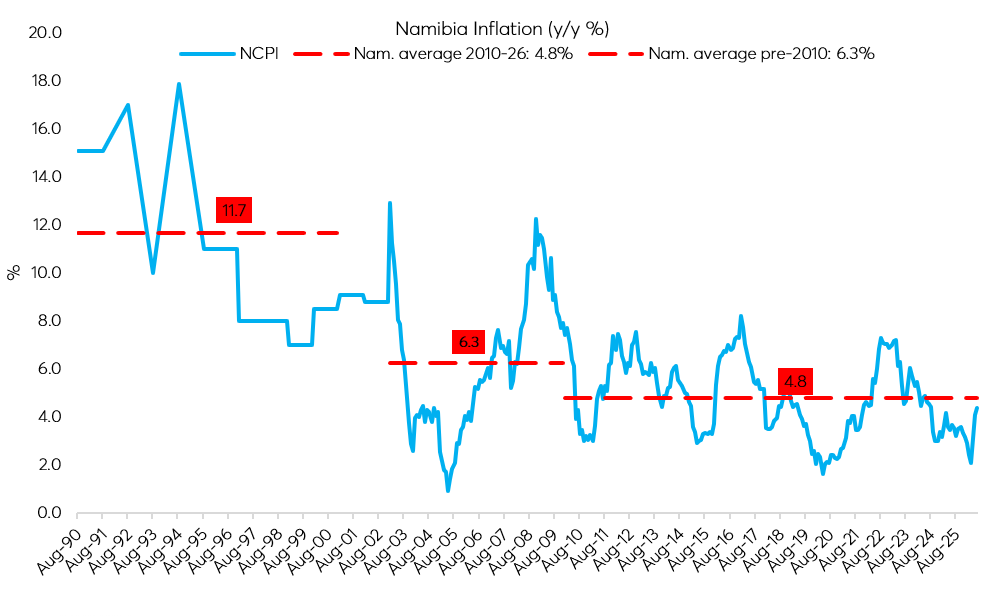
It is also the risk easiest to ignore because the last decade taught investors to stop watching it. US policy rates sat near zero for years and borrowing was close to free, so duration risk went unpunished. US inflation printed below the Federal Reserve's target year after year, and the yardstick everyone measures against stopped moving. The calm was not confined to the developed world. Namibian inflation averaged 4.8% between 2010 and 2026, against 6.3% in the years before and even higher at 11.7% just after independence. Index exposure beat discernment, and concentration began to look like conviction rather than risk.
A generation of portfolios was built in conditions that no longer hold. That conditioning shows up in how portfolios are put together. Where an absolute return fund targets CPI plus 4% and domestic bonds have been delivering close to that on their own, the path of least resistance has been to lean heavily on bonds and let the yield do the work, and many investors now carry fixed income weights built for a world of anchored inflation rather than the one in front of them.
Figure 2: Namibian inflation, NCPI yoy, 1990 to 2025.
Source: Bloomberg, Bank of Namibia
The recent sharp rise in inflation, mainly driven by oil, is only the immediate trigger. The deeper story is a world that has shifted on several fronts at almost the same time. Large deficits and heavy bond issuance are pushing long-term yields higher. Trade and geopolitics have grown more fragmented. Global growth is slower and more uneven. A firmer dollar has tightened conditions across the emerging world. Capital has grown more discerning about where it goes, and more demanding for what it pays to take on risk. Richly valued equity markets, led by the AI complex, have little room for error, and their swings have sharpened. AI infrastructure spending is large and increasingly debt-funded, so widening credit spreads and rising financing costs now feed straight back into that story.
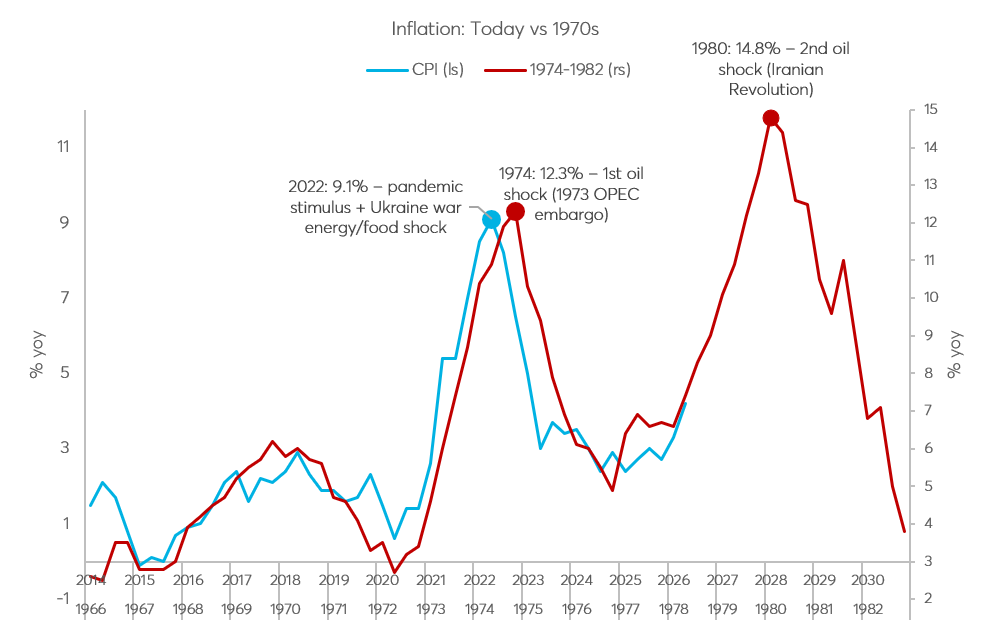
Oil has stirred inflation before, from the 1970s to the surge that followed the pandemic in 2022, though each episode had its own drivers and its own ending. What has mattered more than the trigger is whether expectations stay anchored and whether policymakers respond in time; based on that measure today looks steadier.
Figure 3: Oil-driven inflation spikes — peaks of 12.3% in 1974, 14.8% in 1980 and 9.1% in 2022.
Source: Bloomberg
What turned the 1970s into a lost decade was not the oil price or inflation. It was the response. Wages chased prices, expectations of high inflation were built into wage demands and contracts, and central banks were too slow to act. Inflation only broke when Paul Volcker hiked US interest rates toward 20%.
Fast forward till today and this time, expectations have stayed anchored, central banks have moved early, and there is little demand behind the shock to sustain it. The local response has been measured and deliberate. The South African Reserve Bank raised its repo rate 25 basis points to 7.00% in June, its first increase in three years, and the Bank of Namibia followed by hiking to 6.75%. Neither move was an attempt to choke demand. Each was a signal of credibility, with the SARB defending its new 3% target before higher prices could seep into expectations.
This points to something larger than the next print. The local backdrop has improved too, with fiscal consolidation trimming the risk premium South African bonds once carried, even as growth stays soft. With global rates higher for longer and the inflation target now changed to 3%, nominal yields are below those of the past decade, but real yields are more generous than investors have grown to know. On paper a bond is generally accepted to target around CPI plus 2%, against equities at CPI plus 6%. In practice domestic bonds have delivered well above that, close to the CPI plus 4% an absolute return fund is expected to deliver.
The yardstick itself deserves scrutiny. Headline CPI is not the basket most investors spend against. Healthcare and education enter the index at close to zero inflation, while energy and transport costs have risen at least 15% over the past year, and the weights that matter to a particular household or institution are seldom the ones our statisticians use. An investor's lived inflation rate is often higher than the print, which raises the bar a portfolio must clear.
This leads to a more useful conclusion. At the yields on offer in our market, bonds do one job well; they de-risk the base of a portfolio. The return is contracted rather than hoped for, and it needs no earnings cycle or re-rating. But hitting CPI plus 4% off the bond book alone is a box ticked, not a result. Measured against an investor whose lived inflation runs above the print, a bond-heavy portfolio can clear the index and still lose ground. That is why bonds belong in the base of an absolute return portfolio and not in place of one.
A base, though, is not a portfolio. Brinson, Hood and Beebower's 1986 study of 91 large US pension funds found that a fund's policy asset allocation explained, on average, 93.6% of the variation in its quarterly returns, with market timing and security selection playing minor roles. The finding concerns the variability of a portfolio's returns over time rather than why one fund outperforms another, and later work by Ibbotson and Kaplan put allocation's share of the variation between funds closer to 40%. The direction of the conclusion survives either reading; what a portfolio owns, and in what weight, matters more than which instrument inside an asset class is picked. Setting those weights, and moving them as pricing changes, is where portfolio manager skill shows up.
This is the thinking behind our positioning. The clearest expression of it is the Arysteq Real Return Fund, a multi-asset portfolio managed against a CPI plus 4% target. Bonds form its de-risked base. What the fund adds beyond that base is the allocation decision itself. Holding bonds at a deliberate weight leaves room for equities, commodities and other assets that compound above inflation over longer horizons, and scope to move that mix as relative value changes. Investors already carrying heavy bond allocations hold the base without the decision. Bond income also helps steady returns when equity markets turn volatile.
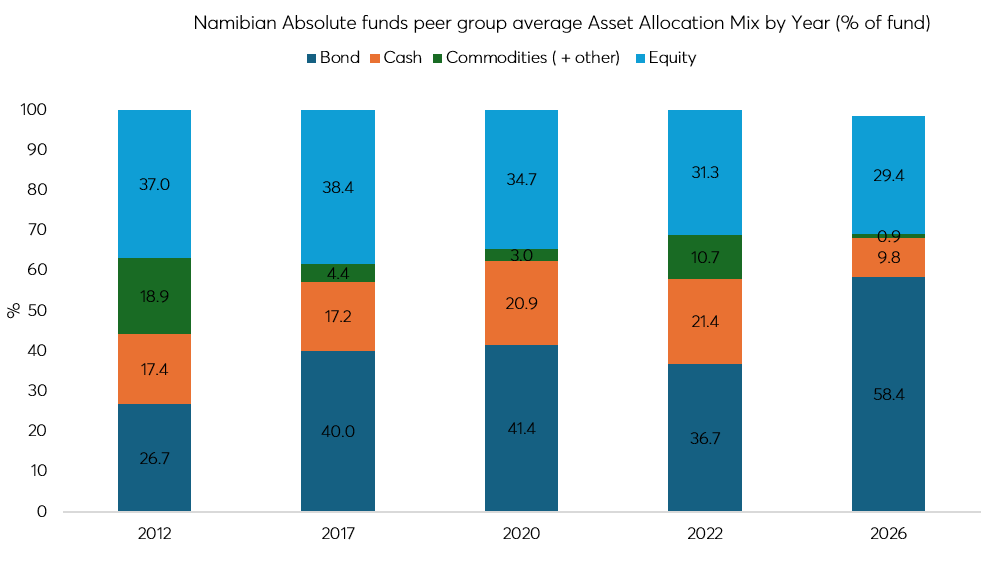
The difference between the two approaches shows up in the numbers. Across the Namibian absolute return peer group, the average bond weighting has risen from 26.7% of fund value in 2012 to 58.4% in 2026, while equity has fallen from 37.0% to 29.4% and commodity and other exposure has all but disappeared, from 18.9% to 0.9%. The target was CPI plus 4%, domestic bonds were delivering close to it on their own, and allocations drifted toward whatever made the target easiest to hit.
Figure 4: Namibian absolute return peer group — average asset allocation by year, 2012 to 2026.
Source: Morningstar
Set against that, the Arysteq Real Return Fund sits at 34.2% underweight bonds against its peer group, 25.3% overweight equities and 11.6% overweight commodities, held within firm limits through active weight deviation, position sizing discipline, independent valuation work, and a willingness to look different from the average fund in our peer group. Precise, targeted risk rather than simply more risk is what carries a portfolio past the traditional absolute return objective of inflation plus 4%. That positioning has added outperformance of 10.3% over the peer group average over the past year, 4.7% over three years and 3.2% over five, and the fund ranks first out of seven in the Namibian absolute return category over each of those periods.
Figure 5: Arysteq Real Return Fund — active positioning against the Namibian absolute return peer group average.

Source: Arysteq, Morningstar
What ties it together is discipline rather than prediction. We do not forecast the cycle; we invest for the long term, because that is the horizon over which real returns compound. The approach is to hold only assets that compensate properly for risk, within firm limits.
For investors, the practical response is not to retreat. Cash feels like safety when prices are moving, but it is the one position that guarantees a real loss whenever inflation runs above the rate on fixed deposits. Protection comes from staying invested in assets that pay enough to compound above inflation, and from holding them long enough for that compounding to do its work. The erosion is slow, and so is the defence against it. Stepping out during volatile stretches usually costs more than the volatility would have. History shows it is the response to inflation, not the inflation itself, that shapes the outcome. So far, that response has been disciplined. Volatility may well return, and a pullback would not surprise us, but short-term noise vs long-term returns are different questions. As investors often say, time in the market, not timing of it, is what answers the latter.
