

Semiconductors play a significant role in our lives. Consider a world without semiconductors (microchips); electrical device wouldn’t exist. A semiconductor is the substance that conducts electricity more than an insulator but less than a pure conductor that is found in thousands of electrical devices.
An average adult spends more than 12 hours every day on devices that have semiconductors, whether it's WiFi, a coffee machine, microwave, computers, televisions, vehicles, or mobile devices. Semiconductors power all of those devices! They are an undeniable part of our daily lives and are critical to the advancement of modern technology.
Electronic devices have become smaller, faster, and more reliable as semiconductor technology has advanced over the last 50 years. As an illustration, today’s smartphones have more computer power than the mainframe computers that NASA used to send Apollo 11 to the moon in 1969. Microchips power nearly every modern electronic device. As the world's objects become "smarter," and demand for electronic devices increases, the need for semiconductors will only continue to soar.
Over the past three decades, the semiconductor industry has experienced rapid growth and delivered enormous economic impact. The semiconductor market grew at an average of 7.5% every year from 1990 to 2020, outpacing the 5% growth of global GDP during that time.
Within this industry, there are 7 types of business models. However, the 3 main models are integrated device manufacturers (IDMs), foundries and fabless. IDMs are companies that design branded chips in-house and own fabrication plants where they manufacture chips (e.g. Intel and Samsung). On the other hand, foundries operate fabrication plants focused on manufacturing chips for other companies, without actually designing them (e.g. Taiwan Semiconductor Manufacturing Company). Fabless companies, including the likes of Qualcomm and NVIDIA, are more or less the opposite and don’t manufacture their own chips, but instead design them and outsource the work to foundries.
More recently, companies like Apple, Amazon, Facebook, Tesla and Google have started designing their own chips and plan on later developing them themselves. However setting up an advanced chip factory might take years as it could cost about US$ 10 billion. Most of these chips are currently manufactured in Taiwan, which is where 51% of the global chips are produced. This means that foundry companies (such as Taiwan Semiconductor Manufacturing Company) benefit from this industry trend as they manufacture the chips for these tech companies.
Let’s take automobiles as an example and ask, “who is the best at motor vehicle chips?”. A modern vehicle can easily have more than 3000 chips. It is crucial to realize that an automobile requires processors, memory chips, graphics cards, and so on. In the modern automobiles that we buy, semiconductors allow safety systems and semi-autonomous driver assistance systems. Blind-spot detection systems, backup cameras, collision-avoidance sensors, adaptive cruise controls, lane-change aid, airbag deployment sensors, and emergency braking systems are examples of intelligent functions enabled by semiconductor devices.
Each of these forms of chips used may be manufactured by a different company. The best way to assess competitor positioning within the semiconductor industry therefore, is by the component type, as certain companies may sometimes only specialize in the manufacture or design of a certain type of chip.
Today, every company is either directly or indirectly dependent on semiconductors. As a result, semiconductors should be expected to persist and create a long-term business case that we cannot overlook. In 2021 however, a strange phenomenon was observed. The semiconductor industry experienced a chip shortage! This was due to a combination of factors.
Demand
In addition to increased adoption of 5G devices, people began upgrading their computers, laptops, phones, and other electronic devices in the midst of the pandemic-induced lockdown. During this period, Sony also launched their brand-new PlayStation 5 console, which received rave reviews and millions of pre-orders. Similarly, demand for graphics cards grew as a result of their use in gaming, graphics production, and crypto mining.
Although there was an overall increase in demand for semiconductor chips, as reflected in these and other industries, demand from the automobile industry momentarily took a hit due to factory closures. When these automobile manufacturers eventually resumed production, chip makers already had a backlog of orders to fulfil and thus had much less production capacity to further allocate. In a sense, the Fords and Toyotas of this world were at the back of a very lengthy queue. This severely affected the revenues of these vehicle manufacturers and dealers which interestingly, led to an increase in preowned vehicle sales globally. In the United Kingdom (UK), preowned vehicle sales went up 6.6% in 2021 compared to pre-pandemic level.
Production
On a production side, aside from the pandemic, there were various factors that caused production issues, including Taiwan's worst drought in 50 years, which left TSMC and other manufacturers unable to obtain sufficient supplies of water – critical in chip manufacturing. Other factors, such as factory fires, power outages, and a transportation obstruction at the Suez Canal, also hampered production.
We believe the current backlogs and shortages are only temporary and eventually, these semiconductor companies will be able to meet the growing demand.
The rest of this article focuses on three semiconductor companies that the Arysteq Global Opportunities Fund holds: Intel, Micron and Qualcomm. These companies also happen to be 3 of 7 companies that dominate the $430 billion industry by revenue in 2021 (figure 1).

STOCKS
As part of Arysteq’s investment philosophy, our selection process focuses on three key quality components which are; business quality, management quality and financial quality. Intel, Micron and Qualcomm have proven to have well rounded management teams that are able to stand the test of time and continuously generate value for shareholders, through predictable and proven earnings and growth, whilst remaining ethical.
These companies are also set apart from their competitors in terms of their unique positioning in the industry as well as their individual competitive advantages. With the ever-changing semiconductor industry, companies need to be at the forefront of their respective industries.
In our view, Intel, Micron and Qualcomm check all our quality boxes.
Intel
Intel was founded in 1968 and is one of the largest and most recognized semiconductor companies in the world. Intel’s initial products were random access memory chips, which were successful and the first chips capable of storing a significant amount of information.
Intel has dominated the PC chip market with its Intel Core processor family. I am sure if you look down on your laptop, you might just see an Intel sticker. The company's latest data centre solutions target a wide range of use cases within cloud computing, network infrastructure, intelligent edge applications and support high-growth workloads, including AI and 5G.
Management has proven to have excellent capital allocation abilities and has recently incurred significant capital expenditure in building the company’s new fabrication plants in Arizona, US. These plants will be used to support the growing demand for Intel chips. Despite the large reinvestment of capital, the company still regularly manages to generate superior profits (figure 2) and sector-leading margins, with normalized net income growing by an average of 10.9% and normalized free cash flow by an average of 10.4% yearly since 2015.
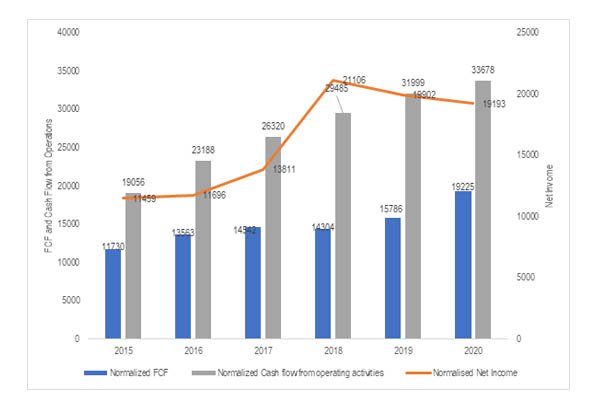
Similarly, return to shareholders has also been exceptional. The company managed to return over $40 billion in dividends and over $52 billion in buybacks since 2013.
From a valuation perspective, Intel trades at a Price to Earnings (PE) multiple of 11.7x which makes it more relatively affordable compared to the MSCI semiconductor index which is currently trading at 27.7x, as well its historical average.
Micron
Micron was founded in 1978 and is one of the largest memory chip makers in the world, specializing in memory technologies. Its memory and storage solutions enable disruptive trends, such as artificial intelligence, 5G, machine learning, and autonomous vehicles, in key market segments like mobile, data centre, graphics, automobile, and networking. Micron happens to be a market leader in graphics cards and is busy venturing into AI especially related to automobiles.
The company appointed a new CEO in 2017, Sanjay Mehrotra. Since then, management has become very efficient with cost control, which reflects highly in their growing margins. Net income grew by an average of 2.9% every year since 2015 and gross margins by an average of 4.7%.
Micron operates in a DRAM (Dynamic Random Access Memory) market that is dominated by an oligopoly of Micron, Samsung and SK Hynix. Micron happens to be the biggest player in the US, thus giving it a strong competitive advantage (figure 3).

In 2021, Micron implemented a quarterly dividend of $0.10 per share for the first time ever and also implemented a share buyback scheme of up to $10Bn in 2020.
Like Intel, Micron trades at a discount (PE of 9.6x) compared to the MSCI semiconductor index currently trading at 27.7x, Nasdaq composite Index trading at 34.1x and is in line with its historical average.
Qualcomm
Qualcomm is known for designing wireless telecommunications products. Qualcomm is a leader in the development and commercialization of foundational technologies for the wireless industry. The company has continued to play a leading role in developing system level inventions that have served as the foundations for the 3G, 4G, and 5G wireless technologies that we see today. As a matter of fact, in 2021, Qualcomm dominated the 5G baseband market with 55% market share (figure 4).

In addition to 5G, Qualcomm’s management has also begun to diversify away from its core business (handsets), and it looks increasingly like an under-the-radar metaverse company. The metaverse is a topic we may discuss in future newsletters, so watch this space. Overall, Qualcomm derived about 38% of its revenue outside its core handset market in 2021.
Similar to Intel and Micron, Qualcomm’s management has proven to be very efficient in terms of cost control and capital allocation over the last 5 years. Net income grew by an average of 11,8% and free cash flow by an average of 6,3% yearly since 2015. Similarly, profits have been increasing for the last 4 years and margins have consistently been the highest amongst peers (figure 5).

Qualcomm trades at a PE of 17.0x that is lower than its historic average, the Nasdaq composite Index trading at 34.1x as well as the MSCI semiconductor index trading at 27.7x.
Overall, we continue to believe the company’s diversification efforts and improving profitability are both underestimated and boast an impressive outlook.
CONCLUSION
It is evident why these companies have stood the test of time and why we value them as good quality stocks to own in our offshore portfolio. The quality shines through and they each have their own competitive advantage within the semiconductor industry. Despite the slight production issues that this industry is currently experiencing, these particular companies still manage to generate above average returns. Moreover, it is evident how important semiconductors are in a number of industries. They play an important role today and will continue to play an important role in an Internet of Things (IoT) environment, where physical devices of all types will be connected to the internet and effortlessly collect and share data through 5G networks, thus, driving future growth. As a unitholder in our Global Opportunities Fund, you are well-placed to have a share in this growth.
