

In 2020, we noted how for as long as we could remember, money market products had been the preferred savings vehicle for most Namibians, with two thirds of retail funds having been invested in this asset class. Namibians have always demonstrated a conservative approach to savings and investing and this has always been supported by reasonable yields, stable inflation, favourable tax rates on investments as well as a strong financial system and stable economy. Fast forward to 2023 and the landscape differs only slightly. Though we still have a strong financial system, relatively stable economy and attractive tax rates on investments, inflation has risen quite rapidly to an average of 7.0% over the past six months (see Figure 1).
Figure 1: Rate of inflation in Namibia, since 2003

Source: Arysteq/Bloomberg
Back in 2020, with the prolonged recession that Namibia was suffering, together with the negative effects of COVID-19, the question was whether it remained appropriate to take exposure to money market products and whether the fundamentals supported good credit, liquidity and market risk. In the current circumstances, we believe this question still holds relevance in the eyes of our fellow Namibians.
The construct of money market funds
As a principle, money market products are constructed with highly liquid fixed-income instruments that are of short-term duration. They also attempt to invest in instruments that are attached to strong quality credit ratings. They carry a yield that is distributed on a monthly basis and while the capital isn’t explicitly guaranteed in most cases, they should not lose you any capital. Due to the natural demand in Namibia, we have historically enjoyed a wide range of instruments to invest in, which has resulted in a flourishing marketplace with ample solutions for investors to choose from.
At Arysteq, our preferences with regard to this asset class are Government instruments (dependent on maturity, liquidity, and price), bank-issued bonds, and high-quality corporate paper within the common monetary area. Below, we will discuss our position on the banking sector, the Government of Namibia, and the economy.
Banking – the bellwether of the economy
The banking sector is critical to any economy, as by our calculations between 88.0% and 92.0% of all spending is done on credit. Since spending drives economic activity, quality credit growth is required for stable long-term economic growth. While banking conditions have deteriorated since 2015, as recessionary conditions set in, we have continued to see resilience in the banking system and in fact, a slight recovery in private sector credit growth. Uptake by the private sector trended higher in 2022 than in the two years previously.
Our analysis suggests that the banking systems in both Namibia and South Africa have demonstrated a sufficient capital adequacy position with total capital ratios well above the minimum capital requirements set by the Bank of Namibia (BON) and the South African Reserve Bank (SARB). This was our position in 2020 when we first published this piece. Two years on, we remain firm on this (see Figure 2).
Figure 2: Total capital adequacy of SA and NAM Banks

Source: Arysteq/Bloomberg
The Economy and the influence of the Namibian Government
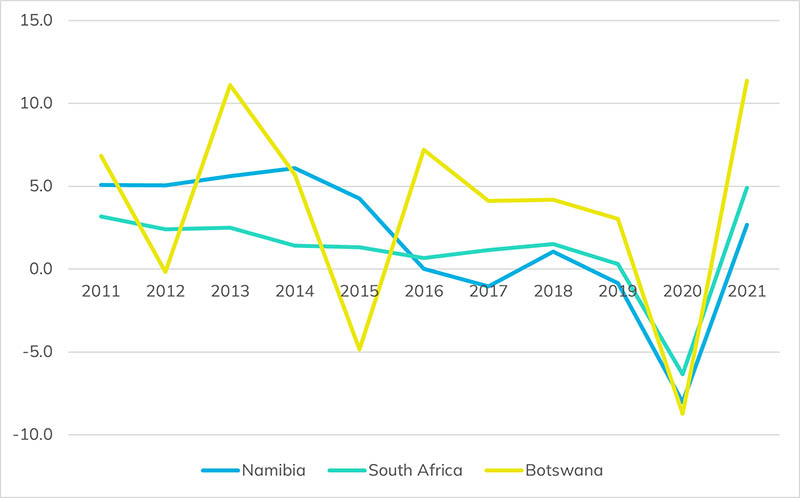
Namibia has been in a prolonged depression and has exhibited sluggish GDP growth since 2015. After a sharp decline in 2015, growth has been on a downward trend. South Africa exhibits a similar trend (see Figure 3). Interestingly, during this period, Botswana has shown stronger growth amongst its peers on the back of a recession that ended in 2015. It’s worth noting that their economy is more concentrated in the diamond mining sector.
This slowdown in economic activity and resultant contraction was caused by a perfect storm of external shocks that permeated through our economy, as commodity prices dropped sharply, a construction bubble turned into a crisis, a drought ensued, and austerity measures were implemented by an overextended government. Except for construction, the same factors hindered South Africa. Additionally, numerous corruption scandals came to light both in South Africa and Namibia. At the time of original writing, COVID-19 was further exacerbating the challenges facing the region. However, a sharp rise in commodity prices (partly due to the Russia and Ukraine military effort; partly due to the supply chain disruptions) as well as a slight recovery of the tourism sector in 2022 has alleviated some of the pain.
Figure 3: GDP growth rates in Namibia, South Africa and Botswana, since 2011
Source: Arysteq/Bloomberg
The condition of the fiscal position became a point of focus as the government had become a significant part of the Namibian economy. The precarious state of government finances resulted in little fiscal room due to:
- Namibia already having the highest tax revenues in the region as a percentage of GDP,
- Overreliance on SACU receipts,
- Austerity measures being suffocated by the outsized wage bill, and
- Debt to GDP ratio having increased over the last 13 years to 70.0%.
As of the 2021/2 financial year, our fiscal deficit is estimated to be N$16.8 billion, according to the Namibia Financial Stability Report released for April 2022.
Fiscal Policy Reform Recommendations
In light of the above situation, we still believe that the only solution is in looking at ways in which we can increase productivity sustainably. We can’t help but feel that while there have been a number of factors that were beyond our control, there are a number of factors that we believe are actually within our reach. Herewith a list of reforms that we believe can improve productivity in Namibia:
- Providing tax relief and opening up the economy to drive foreign direct investment (FDI) into Namibia (Note: Despite seeing improved FDI since last year, the Namibia Investment Promotion and Facilitation Bill still deters FDI. This policy uncertainty must be addressed to increase FDI).
- Government to reduce its interference in the private sector and to rather focus more on ensuring fair competition amongst private sector participants.
- Targeted import replacement initiatives especially as it pertains to the agricultural sector, including the advancement of the manufacturing sector to produce goods that substitute these imports.
- Optimising government efficiency needs to be a priority.
- Corruption has been a large downfall in the efficiency of bureaucratic development. More stringent laws and actions thus need to be undertaken in order for this to be corrected.
Where does our comfort lie?
While the ratio of foreign reserves to short-term debt has been decreasing over the last 7 years, it remains sufficient at 2.2x to address any short-term liquidity needs our country may have (see Figure 4).
Figure 4: Foreign reserves cover over short-term debt

Source: Bank of Namibia/Arysteq
Further, there are mixed views in the market about the currency peg to the South African Rand. We believe that while the South African Rand has depreciated significantly over time, it remains one of the most suitable monetary policies as this link to the second largest African economy allows Namibia to retain better price stability, save on transactional costs on transactions with South Africa and protect Namibia against currency volatility (and thus from exceedingly high inflation).
Finally, while external sources of funding from foreign governments and intergovernmental organisations like the IMF are politically unpopular, they still remain an option of last resort.
What does this mean for your savings and investments?
Investors should remain confident in the creditworthiness of their money market products. As indicated earlier, we are satisfied with the credit risk inherent in our Money Market Fund and we are equally satisfied that we will be able to repay investors should they wish to make withdrawals, especially as they feel the pinch of the rising cost of living.
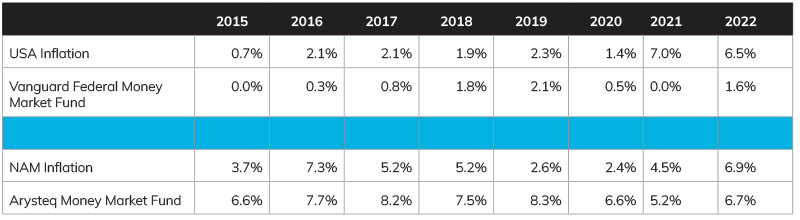
The global COVID-19 pandemic that befell us in 2020 compelled central banks to cut rates globally. In a similar fashion, in the last twelve months, these central banks have been compelled to raise rates to curb rising inflation. Some money market rates have risen sharply as a result. Our money market fund, the best on offer, has risen from 5.2% at the beginning of 2022 to 7.4% at the end of Dec 2022.
We continue to remind investors to have a portfolio that is appropriately balanced to their risk and return objectives and refrain from holding a significant amount of their wealth in one specific basket. In Namibia, we can consider ourselves rather fortunate that money market rates historically have generally exceeded inflation and thus preserved our purchasing power. Our American counterparts cannot say the same (see Figure 5).
Figure 5: Analysis of inflation-adjusted returns from money market funds, in Namibia and USA.
Source: Arysteq/Bloomberg
In our view, however, we are merely at the onset of a prolonged period of inflation higher than what we have become accustomed to over the past few years. We therefore remind investors that these money market products, while they may have provided inflation-beating returns in the past, will not be suitable for the goal of preserving one’s spending power going forward. Rather, we recommend readers to invest in the Arysteq Real Return Fund which has the explicit return objective of exceeding inflation + 3% on a rolling 3-year cycle.
