
There is a tendency in markets to focus on what is new — the latest technology, the next growth story, the companies reshaping industries. Today, that narrative is firmly centred on artificial intelligence, data infrastructure, and the transformative potential of compute amongst others. What is often overlooked is something far more fundamental and obvious we think: energy. While innovation changes the shape of economies, it rarely changes one underlying truth that growth requires energy. And at certain points in the cycle, the demand for that energy begins to matter in ways that investors cannot ignore. There is a link in the development of any country or nation to its access to or the availability of energy.
Figure 1: History of Crude Oil Prices

Source: Arysteq/BP/Federal Reserve Bank of St. Louis/Goldman Sachs
History provides a useful lens (see Figure 1). Periods of major innovation — the kind that captures imagination and capital — have consistently been accompanied by rising energy demand:
Each of these periods required not just capital and ideas, but significant increases in energy availability. And in each case, energy — particularly oil — began to rise meaningfully as demand caught up with supply. This is not coincidence. It is a structural feature of growth.
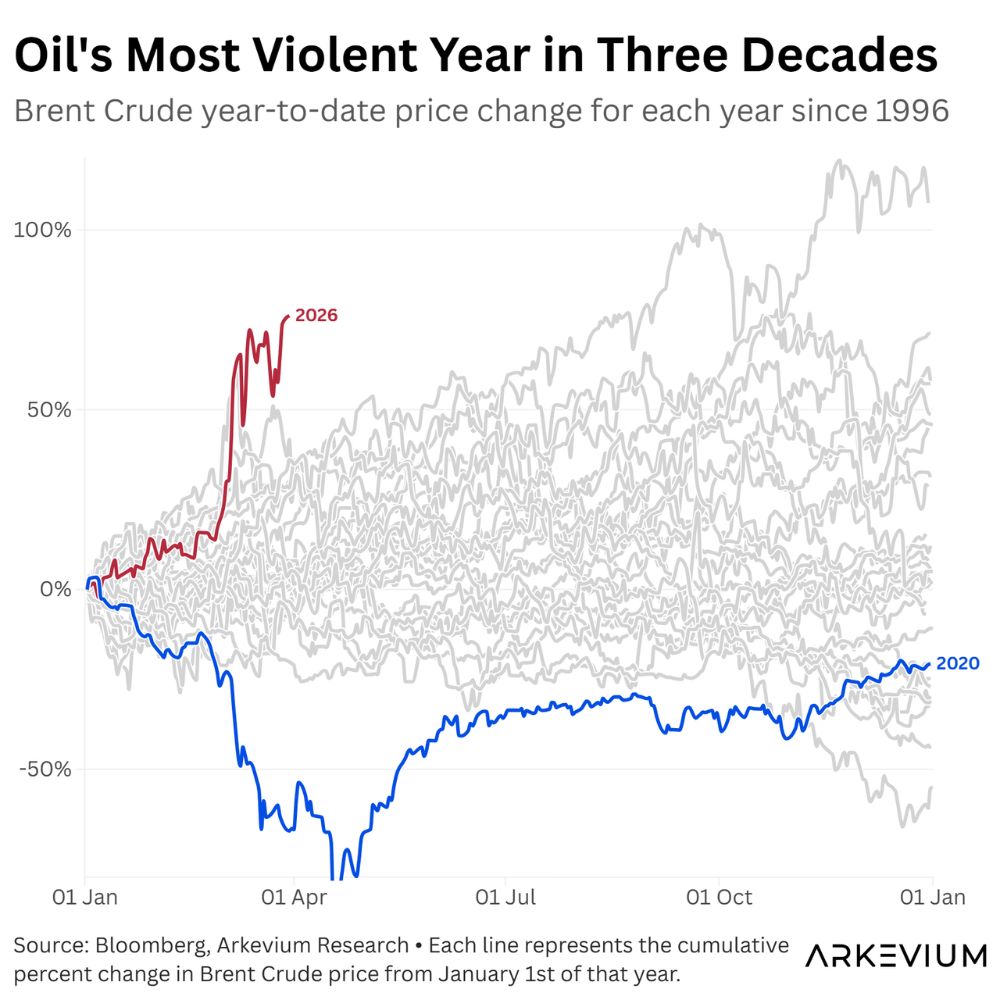
Figure 2: Brent Crude YTD price change for each year since 1996
Source: Arysteq/Maxence Visseau
One of the more counterintuitive aspects of market cycles is that oil prices and equity markets often rise together, particularly toward the latter stages of an expansion. Strong economic activity drives demand for both, meaning that corporate earnings improve supporting equity markets and energy consumption rises, supporting oil prices (see Figure 2). For a time, this coexistence appears benign and maybe even supportive. But it is also where the seeds of the next phase are sown. As energy prices rise, they begin to feed into the broader economy as input costs increase, inflation expectations rise and margins come under pressure. And importantly, financial markets begin to respond.
The transmission mechanism from oil to markets is not immediate but has been consistent. Rising energy prices contribute to higher inflation expectations. Bond markets adjust accordingly, with yields moving higher to reflect that inflation risk. Central banks, in turn, are forced to respond. Policy becomes tighter. Liquidity becomes constrained. At some point, the yield curve — the relationship between short-term and long-term interest rates — begins to invert. Historically, this has been one of the more reliable indicators that financial conditions have become restrictive. From there, the effects tend to compound and demand begins to slow, corporate earnings come under pressure, risk appetite fades and equity markets eventually reprice. This sequence has played out across multiple cycles. It is rarely linear, and never perfectly timed but the pattern is familiar.
The current environment shares several of these characteristics. The global economy continues to absorb significant capital, much of it directed toward technology and infrastructure linked to artificial intelligence. Data centres, cloud computing, and digital networks are not only capital-intensive, but they are also energy intensive. At the same time, the supply side of energy markets has remained relatively constrained. Years of underinvestment, combined with capital discipline among producers and geopolitical considerations, have limited the ability of supply to respond quickly. The result is a tightening dynamic where structural demand is rising, supply remains measured and pricing power is gradually shifting. Importantly, this can occur alongside strong equity markets. In fact, it often does.
Looking ahead, there are several reasons to expect that oil prices could remain supported over the next three to five years. Firstly, supply discipline remains a defining feature of the market. Producers are prioritising returns over volume, limiting the kind of overinvestment that has historically led to price collapses. Secondly, demand is evolving rather than disappearing. While the energy transition is underway, it is neither linear nor immediate. Traditional energy sources continue to play a critical role in supporting global growth, particularly as new technologies increase overall energy requirements. Thirdly, spare capacity remains limited, leaving the market more sensitive to disruptions, whether geopolitical or operational. Taken together, these factors suggest that energy markets are likely to remain tighter than consensus expectations imply.
For investors, the significance of this environment lies in how it shapes relative opportunities. Energy has historically been viewed as cyclical and, at times, unpredictable. Yet in the current context, it offers several characteristics that are increasingly valuable:
At the same time, many parts of global equity markets continue to reflect elevated expectations, particularly where growth narratives remain dominant. This creates an unusual dynamic — where one part of the market is priced for continued optimism, while another is supported by tangible, near-term fundamentals.
Within the Arysteq Global Opportunities Fund and the Arysteq SA Equity Fund, our overweight exposure to energy reflects this imbalance. It is not a view based on short-term price movements, but rather on:
Importantly, this positioning sits alongside a diversified portfolio of global equities, where we continue to focus on quality and valuation discipline. Market cycles rarely end because investors lose interest. They tend to end because constraints begin to matter — whether in the form of higher costs, tighter financial conditions, or shifting expectations. Energy is often one of the earliest signals of those constraints. Today, as innovation accelerates and capital continues to flow, energy demand is rising once again. Oil prices are responding accordingly. This does not signal an immediate turning point for markets. But it does suggest that we may be moving deeper into a phase of the cycle where pricing, discipline, and selectivity become increasingly important. And in that environment, energy is not just part of the backdrop — it is part of the story.
As a final thought, it is worth reflecting on a perspective often articulated by Charlie Munger, who challenged the conventional notion of energy independence from non-renewable resources. He argued that such thinking can at times be shaped by short-term incentives and overly simplistic economic assumptions. In his view, fossil fuels — and oil in particular — are a finite and “precious” resource, not merely to be consumed, but to be managed thoughtfully over time. While current market dynamics point to a continued and essential role for oil within the global economy, his comments serve as a reminder of the longer-term transition already underway. The balance between meeting today’s energy demands and preparing for a more sustainable future is not a contradiction, but a defining investment consideration. It is a tension that investors would do well to keep in mind when allocating capital in the yea
