
Inside Our Investment Process — The Reinet Case
A closer look at how we move from an idea to an investment decision, using our recent purchase of Reinet Investments for the Arysteq SA Equity Fund as an example.
Imagine being offered a wallet for N$66 when you can see N$100 of cash inside it. You would not need to be an expert in leather to take advantage of that offer. The harder questions come next: can you get the money, who is holding the wallet, and how long are you prepared to wait to get the cash? That is close to the situation we found in Reinet Investments (RNI-JSE). On the surface, none of those questions has a straightforward answer, and working through them, as a team, and with a margin of safety — is the same disciplined path every idea travel in our process before it earns a place in client portfolios. Reinet is a good example of that process in action, and of why we ended up with real conviction in this opportunity.
Idea generation and screening: Ideas reach us from many directions: our own research, market screening, company results and SENS announcements, and the internal debates we hold in meetings such as Investors Guild and our JSE Movers & Shakers review. Reinet arrived as a valuation dislocation — a holding company trading at a wide and persistent discount to the value of the assets it owns. Before we commit real research time, every idea is screened for liquidity, mandate fit, financial strength and a high-level look at valuation. Reinet cleared that screen comfortably: it is liquid, mandate relevant, and on first inspection was trading below even its cash holdings. A cheap-looking share earns a closer look; what turned this one into a conviction idea was the quality of what sits behind the discount.
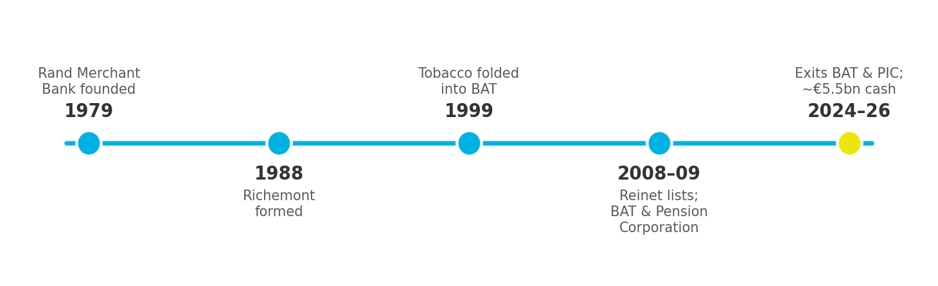
A long pedigree: To understand Reinet, it helps to understand where it comes from, because the lineage is long and consistent. Its roots run back more than four decades, through some of the most successful capital allocation decisions in South African corporate history, and the same patient, contrarian, owner-minded approach runs through all of it (see Figure 1).
Figure 1: A four-decade lineage of patient capital allocation
Source: Arysteq / Reinet FY2026
Johann Rupert founded Rand Merchant Bank in 1979 and went on to build Compagnie Financière Richemont, the luxury goods group, in 1988. When the family’s tobacco interests were merged into British American Tobacco (BAT) at the end of the 1990s, that holding became the seed of what would later be spun out. Reinet itself was created in 2008, listed in Luxembourg with Johann Rupert as chairman, and by 2009 held a substantial BAT stake alongside a new investment in the United Kingdom’s Pension Corporation. For much of the next decade those two holdings defined the company. The most important recent chapter is what happened next: between 2024 and 2026 Reinet fully exited both BAT and Pension Corporation, turning two long-held, concentrated positions into cash at a time of its own choosing. The result is a business that has de-risked itself and now holds a great deal of optionality — exactly the kind of deliberate, unforced capital allocation we like to see from owners who think in decades rather than quarters.
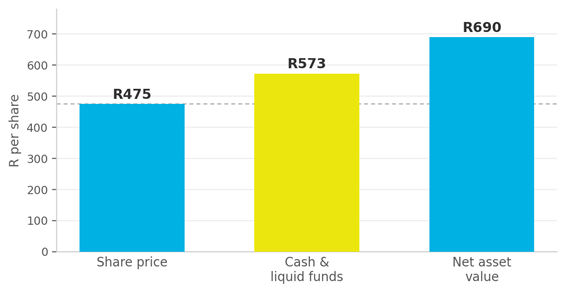
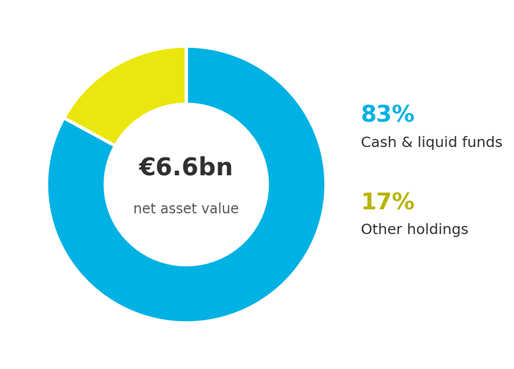
Fundamental research: Reinet is a Luxembourg-domiciled investment holding company, controlled by the Rupert family and chaired by Johann Rupert. After the disposals it now sits on roughly €5.5 billion of cash and liquid funds — about 83% of its €6.6 billion net asset value — held principally with European banks and in liquidity funds invested in highly rated short-term instruments. In other words, this is genuinely low-risk cash, not a portfolio of speculative bets dressed up as liquidity. Most of the company, today, simply is cash (see Figure 2 and Figure 3). Put plainly, we were being offered a basket made up overwhelmingly of cash, plus a few carefully chosen investments, for less than the value of the cash on its own.
Figure 2: Reinet trades below the value of its own cash (R per share)
Source: Arysteq 30/06/2026
Figure 3: After the BAT and Pension Corporation exits, most of Reinet is cash
Source: Arysteq 30/06/2026
The discount, in context: Holding companies of this kind have long traded below the sum of their parts. The reasons are well understood — management fees, the layer of structure between owner and assets, the illiquidity of some underlying holdings, and, above all, uncertainty about what will be done with the capital, in this case the cash. A discount is therefore not unusual for Reinet; it has been a feature for much of its life. What matters is that these discounts are persistent but not static: they tend to widen when the market is unsure what management will do with its money, and to narrow around concrete catalysts such as buybacks, distributions or realisations (see Figure 4).
Figure 4: Reinet’s discount to NAV over time

Source: Arysteq / Bloomberg
What makes the present level genuinely interesting is not simply that the discount is wide, but what sits underneath it. A discount applied to a portfolio of uncertain, speculative assets is one thing; a discount applied to a balance sheet that is more than four-fifths cash is quite another. At a price of about R475 against an estimated net asset value of roughly ZAR690 a share, the shares trade at a discount to NAV of around a third — and, most tellingly, below the value of the cash alone. The market is effectively assigning little value to Reinet’s remaining investments and nothing at all to the optionality of €5.5 billion of cash. We would rather be approximately right over time than precisely wrong in the short term, and a margin of safety anchored to cash, rather than to a forecast, is about as solid a foundation as we find.
Back in our Enterprise Room (The Arysteq boardroom), the same three principles that guide everything we do shaped the decision from here:
Quality assessment: On the people holding the wallet, the positives stack up. The Rupert family are long-term owners with a record of compounding capital across luxury goods, tobacco and financial services through several full market cycles — they returned more than three times the capital originally invested in Pension Corporation, and Reinet’s net asset value has grown at roughly 8.2% a year in euros since 2009, a period that spans the aftermath of the global financial crisis, the pandemic and a full interest-rate cycle. Their own wealth sits alongside that of fellow shareholders, so they think and act like owners because they are. That alignment shows up in discipline as much as ambition: investment parameters are unchanged, with single investments generally kept to within 30% of NAV, and management has been explicit that it regards market risk as high at the moment and is content to hold a de-risked, cash-heavy book rather than chase a deal for its own sake. The balance sheet reflects the same conservatism — minimal holding-company debt, concrete cash generation and ample liquidity. Our quality analysis captured this, scoring management and financial strength reasonably high, for a high overall quality rating. It is precisely the owner-operator, clean-balance-sheet profile our house view is built to find.
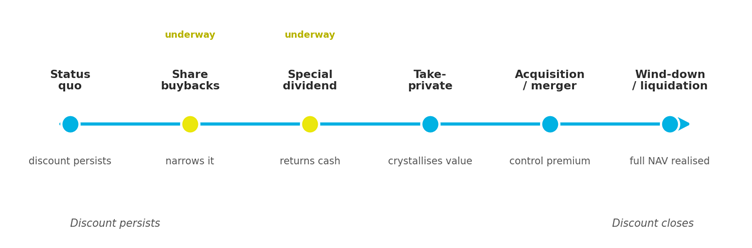
Why we have conviction: Conviction, for us, is not the absence of risk; it is a favourable balance between what we pay and what can happen next. On that test Reinet scores very well. Begin with the downside: because the price sits below the cash, the balance sheet itself provides a floor, so we are not relying on a re-rating simply to avoid losing money. Add the optionality — €5.5 billion of cash in the hands of proven allocators, with a mandate flexible enough to make a transformational investment should the right one appear. Then add the catalysts, which are no longer hypothetical: management has announced a €500 million share buyback — a buyback yield close to 9% — which is immediately accretive while the shares trade below NAV and has raised the dividend by about 17%. These are concrete, shareholder-friendly uses of cash, and they tell us the family is actively working to narrow the discount gap rather than sit on it.
Figure 5: Most paths from here narrow the discount — and two are already underway
Source: Arysteq / Reinet FY2026
Crucially, there is a whole range of ways the discount can close from here — continued buybacks, a special dividend, taking the company private, a corporate transaction, or an eventual wind-down — and almost all of them work in our favour. The least helpful outcome is simply that nothing dramatic happens, in which case we continue to collect buybacks and a rising dividend while we wait, having bought below the value of the cash on the balance sheet. When the outcomes are skewed that far in one direction, and the entry price is below the cash as stated, the case earns genuine conviction (see Figure 5).
Portfolio fit: A standalone-attractive idea must also earn its place in the portfolio. Here Reinet does something useful. Much of the JSE All shares recent strength has been concentrated in a small number of very large companies, where expectations — and valuations — leave little room for disappointment. A cash-backed holding company bought below the value of its own cash behaves quite differently: its return does not depend on that crowded trade continuing to work, which makes it a genuine source of diversification rather than more of the same risk in a different wrapper. Its underlying assets are euro-denominated, so the position also carries a measure of rand-hedge attributes. Sized sensibly as an active position in the Arysteq SA Equity Fund, it improves the balance of the portfolio as a whole — adding optionality without adding to the overall risk.
The team debate: We are not naive about the one real risk. Reinet is not an ordinary company; its structure means minority shareholders cannot, on their own, force the discount to close — a great deal ultimately rests on the judgement of the family that controls it. We debated that openly rather than wishing it away. Being deliberate meant sizing the position to reflect that we are, in the end, backing the Ruperts to keep doing what they have done for forty years: allocate and return capital well. Given the record, we are comfortable making that bet; given the structure, we are mindful of how large to make it.
The decision: The mantis shrimp delivers the most powerful strike in the ocean relative to its size — not because it is large, but because it waits and strikes only when the odds are best. With a price below cash, a proven owner at the helm, substantial dry powder and catalysts already in motion, the odds had tilted firmly in our favour, and we initiated a position for the Arysteq SA Equity Fund. In investing, as in nature, precision tends to beat power. We will not be right every time — no one is — but a process built on quality, patience and a margin of safety does not depend on being right every time. It depends on being deliberate about where, and how much. On Reinet, we were both.
